Artificial Intelligence, Machine Learning, and Deep Learning are among the most widely discussed technologies in the digital world. While these terms are often used interchangeably, they represent different concepts within the broader field of AI. Understanding their differences is essential for anyone interested in technology, business, or data science.
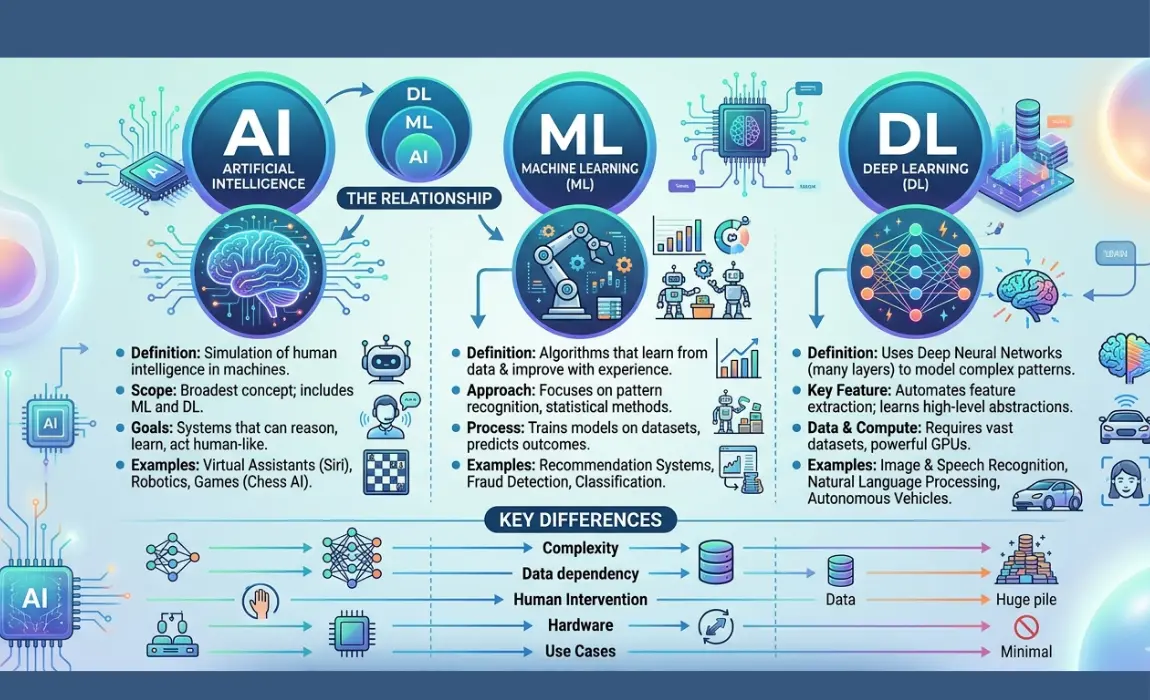
Artificial Intelligence is the overarching concept that focuses on creating machines capable of performing tasks that require human intelligence. Machine Learning is a subset of AI that enables systems to learn from data and improve over time. Deep Learning is a further subset of machine learning that uses neural networks to process complex data.
These technologies are interconnected but serve different purposes. AI provides the foundation, machine learning adds adaptability, and deep learning enhances performance for complex tasks. Together, they form the backbone of modern intelligent systems.
This guide will provide a complete comparison of AI, machine learning, and deep learning. It will cover definitions, differences, examples, and use cases to help you understand these technologies clearly.
What is Artificial Intelligence (AI)?
Artificial Intelligence is the simulation of human intelligence in machines. It involves creating systems that can perform tasks such as learning, reasoning, and problem-solving. AI is the broadest concept among the three and includes various technologies and approaches.
AI systems are designed to mimic human cognitive functions. They can analyze data, recognize patterns, and make decisions. This makes AI suitable for a wide range of applications, from virtual assistants to autonomous vehicles.
One of the key features of AI is its ability to automate tasks. This reduces manual effort and improves efficiency. Businesses use AI to streamline operations and enhance productivity.
AI also enables innovation by providing new solutions to complex problems. It plays a crucial role in advancing technology and shaping the future.
What is Machine Learning (ML)?
Machine Learning is a subset of AI that focuses on learning from data. It involves creating algorithms that can analyze data and make predictions. Unlike traditional programming, machine learning systems improve over time with experience.
ML models are trained using datasets. They identify patterns and use these patterns to make predictions. This makes them suitable for tasks such as recommendation systems and fraud detection.
There are different types of machine learning, including supervised learning, unsupervised learning, and reinforcement learning. Each type serves a specific purpose and is used in different applications.
Machine learning is widely used in various industries. It helps businesses make data-driven decisions and improve efficiency.
What is Deep Learning (DL)?
Deep Learning is a subset of machine learning that uses neural networks to process data. These networks are inspired by the human brain and consist of multiple layers. This allows deep learning models to handle complex tasks.
DL is used for tasks such as image recognition, speech recognition, and natural language processing. It can analyze large datasets and identify patterns with high accuracy.
One of the key advantages of deep learning is its ability to process unstructured data. This includes images, videos, and text. This makes it suitable for advanced applications.
Deep learning requires significant computational power and data. However, its performance and accuracy make it a valuable technology.
Difference Between AI, Machine Learning and Deep Learning
Artificial Intelligence (AI) is the broad concept of machines performing intelligent tasks.
Machine Learning (ML) is a subset of AI that learns from data.
Deep Learning (DL) is a subset of ML that uses neural networks for complex tasks.
In short:
AI > Machine Learning > Deep Learning
AI vs Machine Learning vs Deep Learning
| Feature | Artificial Intelligence | Machine Learning | Deep Learning |
|---|---|---|---|
| Definition | Simulation of human intelligence | Learning from data | Learning using neural networks |
| Scope | Broadest | Subset of AI | Subset of ML |
| Data Requirement | Moderate | High | Very High |
| Complexity | Medium | High | Very High |
| Examples | Chatbots, robots | Recommendation systems | Image recognition, NLP |
| Human Intervention | High | Medium | Low |
Key Differences Explained
The main difference between AI, machine learning, and deep learning lies in their scope and functionality. AI is the umbrella term that includes all intelligent systems. Machine learning focuses on learning from data, while deep learning uses neural networks for complex tasks.
AI systems can work without machine learning, but modern AI relies heavily on ML. Similarly, deep learning is a specialized form of machine learning that offers higher accuracy for complex problems.
Another key difference is data requirement. Deep learning requires large datasets, while machine learning can work with smaller datasets. This makes ML more accessible for beginners.
Understanding these differences helps in choosing the right technology for specific applications.
Types of Machine Learning
Machine learning can be categorized into different types based on how models learn from data. The main types include supervised learning, unsupervised learning, and reinforcement learning.
Supervised learning involves training models using labeled data. This allows the system to make predictions based on known outcomes. It is commonly used in applications such as classification and regression.
Unsupervised learning involves analyzing unlabeled data to identify patterns. This is used for tasks such as clustering and anomaly detection. It helps in discovering hidden structures in data.
Reinforcement learning involves training models through trial and error. The system learns by receiving rewards or penalties. This approach is used in applications such as robotics and gaming.
Types of Deep Learning Models
Deep learning includes various models designed for different tasks. Some of the most common models include neural networks, convolutional neural networks (CNNs), and recurrent neural networks (RNNs).
Neural networks are the foundation of deep learning. They consist of interconnected nodes that process data in layers. This allows them to learn complex patterns.
CNNs are used for image processing tasks. They analyze visual data and identify features such as edges and shapes. This makes them suitable for applications like facial recognition.
RNNs are used for sequential data such as text and speech. They can process information in a sequence, making them ideal for natural language processing tasks.
Real-Life Examples of AI vs ML vs DL
Artificial Intelligence is used in virtual assistants and chatbots. These systems can understand and respond to user queries, making them useful for customer support.
Machine learning is used in recommendation systems. Platforms like Netflix and Amazon use ML to suggest content and products based on user behavior.
Deep learning is used in image and speech recognition. Applications such as facial recognition and voice assistants rely on DL for accuracy.
These examples highlight the differences between AI, ML, and DL. They show how each technology is used in real-world applications.
Use Cases in Business and Industries
AI, machine learning, and deep learning are widely used in business and industries. They help organizations improve efficiency and make data-driven decisions.
In marketing, AI is used for automation and personalization. Machine learning helps analyze customer data, while deep learning enhances content creation and targeting.
In healthcare, AI is used for diagnosis and treatment planning. Machine learning analyzes medical data, while deep learning processes images and identifies patterns.
In finance, AI is used for fraud detection and risk management. Machine learning analyzes transactions, while deep learning identifies complex patterns.
Advantages of AI vs ML vs DL
Each technology offers unique advantages. AI provides a broad framework for intelligent systems. It enables automation and innovation across industries.
Machine learning offers adaptability by learning from data. It improves accuracy and performance over time. This makes it suitable for dynamic environments.
Deep learning provides high accuracy for complex tasks. It can process large datasets and identify patterns. This makes it ideal for advanced applications.
Understanding these advantages helps in choosing the right technology.
Challenges and Limitations
Despite their benefits, AI, ML, and DL have challenges. One of the main issues is data requirement. Deep learning requires large datasets, which may not always be available.
Another challenge is computational cost. These technologies require powerful hardware, making them expensive. This can be a barrier for small businesses.
Ethical concerns are also significant. Issues such as bias and privacy need to be addressed. This requires proper guidelines and regulations.
Understanding these challenges helps in implementing these technologies effectively.
Future of AI, Machine Learning and Deep Learning
The future of these technologies is promising. AI, machine learning, and deep learning are expected to become more advanced and integrated into various applications.
New developments will improve efficiency and accuracy. This will enable new solutions and innovations across industries.
These technologies will also create new job opportunities. This highlights the importance of learning and adapting to new trends.
Overall, AI, ML, and DL will continue to shape the future of technology.
Conclusion
Artificial Intelligence, Machine Learning, and Deep Learning are interconnected technologies that drive modern innovation. Understanding their differences and applications is essential for anyone interested in technology.
AI provides the foundation, machine learning adds adaptability, and deep learning enhances performance. Together, they create powerful systems that transform industries.
By learning about these technologies, you can stay ahead in the digital world and make informed decisions.
FAQs
1. What is the difference between AI, ML and DL?
AI is the broad concept, ML is a subset that learns from data, and DL is a subset of ML using neural networks.
2. Which is better AI, ML or DL?
It depends on the use case; each has its own advantages.
3. Is deep learning part of AI?
Yes, deep learning is a subset of machine learning, which is part of AI.
4. Where are ML and DL used?
They are used in healthcare, finance, marketing, and many other industries.
5. Can AI work without machine learning?
Yes, but modern AI systems often rely on machine learning.